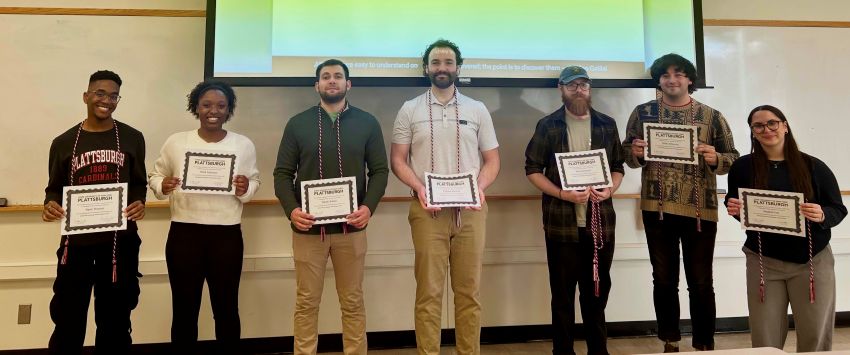
Students in our program have numerous opportunities to collaborate with faculty as
well as develop their own independent research projects. These projects often lead
to publications and/or presentations at regional and national conferences.
Psychology Student Research Panel Presentations
May 1, 2026 — Student researchers presented their work at the Psychology Student Research
Panel, held in Sibley 100. Students have been working hard for one or more semesters
planning their studies, collecting and analyzing data, and organizing their findings.
Projects included studies of agency in AI use, emotion recognition in ASD, action
duration and agency, AI-based counseling, and how music impacts well-being. Congratulations
to all of the researchers on bringing these projects to completion!
“All truths are easy to understand once they are discovered; the point is to discover
them.” — Galileo Galilei
Judgments of agency and culpability for AI use in college: You might not have written
it—but it’s still your fault
Student use of artificial intelligence (AI) in academic work is rapidly increasing,
ranging from minor grammatical assistance to full generation of written content. Because
these scenarios reflect varying degrees of human-AI contribution, they raise important
questions about students’ sense of agency over AI-assisted work. Specifically, do
students feel agency over content generated by AI? In the present study, participants
read a series of short scenarios describing different ways a student used AI to complete
an essay, ranging from no AI input to fully AI-generated work. Participants rated
the extent to which the student possessed agency over the essay. Results indicated
that perceived agency scaled with the level of student involvement, such that greater
human contribution was associated with higher agency ratings. However, frequent AI
users attributed greater agency to the student across the scenarios (F2, 68=6.89, p<.001, η2=.17). Notably, a dissociation emerged between agency and culpability: participants
indicated that the student is accountable for any errors in the essay, even when it
was largely or entirely AI-generated. Taken together, these findings have implications
for how responsibility and authorship are conceptualized in educational settings that
increasingly involve AI tools.
Research has found that, in comparison to their neurotypical counterparts, individuals
with autism spectrum disorder (ASD) showed a decrease in the ability to recognize
emotion in faces that were wearing face masks during the coronavirus pandemic (Ventura
et. al., 2023; Ramachandran, 2021). We examined whether the common usage of face masks
post-pandemic has increased the ability of those with autistic traits to recognize
emotion. We measured the relationship between scores on the Baron-Cohen RMET (a test
of emotion recognition) and the AQ-10 (a brief assessment of autistic traits). Here
we report data collected from 27 students in the PSY105 class at SUNY Plattsburgh,
and we plan to collect additional data in the Fall of 2026. In accordance with our
hypothesis, all participants scored within the typical range of the RMET (22-30).
The 4 participants who scored ≥6 on the AQ-10 (indicating possible autistic traits)
had an average RMET score of 27.5, while the remaining participants had an average
RMET score of 25.8 (t(15.36)=1.63, p=.123). There was a non-significant but positive correlation between scores on the
two tests (r(25)=.377, p=.053). These results indicate that individuals with autistic traits may have improved
their ability to read emotions.
Presenters: Meghan Cox, Teddy Defayette, Myles Maldonado-McCabe, Sean Noworyta
Faculty mentor: Dr. Potts
What can time tell us about agency? Evaluating action duration estimates as a measure
of control.
The sense of agency—the feeling of control over one’s actions and their outcomes—is
a growing area of interest with implications for clinical conditions, design, and
our legal system. Research in this area has relied heavily on self-report measures,
which are vulnerable to bias. Efforts to identify more objective measures have produced
mixed results, focusing largely on temporal binding—the subjective compression of
action–outcome intervals. Here, we examined a novel candidate measure: distortions
in perceived action duration for actions of varied difficulty. Across two experiments,
participants clicked on targets of varying aiming difficulty and either (1) estimated
the duration of their actions or (2) reported their sense of control using a sliding
scale. In Experiment 2, we introduced passive trials in which participants had no
control over cursor movement to further isolate agency-related effects. Results indicated
that action duration estimates were driven primarily by regression to the mean, with
some evidence for increased temporal distortion when participants controlled the cursor.
Together, these findings challenge proposed time-based measures of agency and suggest
that the search for a reliable objective measure remains unresolved.
The growing demand for accessible mental health services has led to considerable interest
in AI-based counseling tools. However, this interest is accompanied by concerns about
data privacy, client safety in crisis situations, and the potential discomfort of
receiving therapy from a non-human agent. To explore this unease, we compared student
ratings of AI-generated therapy with therapy based on real counseling materials. Two
five-minute counseling sessions were created: one generated by ChatGPT and the other
adapted from real counseling training materials. In both sessions, the therapist used
cognitive-behavioral strategies to help a client with anxiety. Participants were randomly
assigned to two groups: in one group, participants were told which session was AI-generated,
while in the other group, they were not. After each session, students rated the therapist’s
effectiveness, and at the end of the study, they indicated which therapist they preferred.
Surprisingly, participants preferred the AI-generated therapist, even when they knew
it was AI-generated. These findings suggest that AI-based therapy may be more broadly
accepted than previously assumed.
In the mood for music: Exploring how making & listening to music affect wellbeing
Our study sought to discover the impact of music on the mental wellbeing of SUNY Plattsburgh’s
students. We investigated the relationship between the students’ recent moods, their
music listening habits, and their musical background in either singing or playing
instruments to see if being exposed to music was associated with the way in which
students feel. The first part of the experiment was administered through a Google
Forms survey, in which we had 100+ students respond to self-report measures. Upon
completion of the survey students were prompted to sign up for the second part of
the experiment, a music-listening or music-playing activity. The students assigned
to the music-making condition replicated the kick drum rhythm played in a musical
arrangement while the students assigned to the music-listening condition listened
to the arrangement mindfully. Data analysis is ongoing, but preliminary results of
the post-intervention survey indicated that participation in the music activity contributed
to a positive mood in the majority of respondents. Responses for the ‘self-conscious’
measure were the most varied of the survey, with 40% of students reporting that they
experienced high degrees of self consciousness. Students also reported feeling a neutral
or weak connection to the people around them during the music activity. 85% of the
students were also able to recognize and correctly identify the arrangement played
in the study. Further analyses will compare these experiences between the two music-activity
groups, and explore associations between students’ musical background, personality
variables, and wellbeing.
Braje, W. L., Mansfield, J. S., Cubillo-Dreher, D.,* Delles, D.*, Guyer, K.*, Parmeter,
C.*, Peroza, H*., & Racicot, G*. (2026, February). Memories of the 2024 solar eclipse:
Clear or cloudy? Poster presented at the Eastern Psychological Association annual
conference, Boston, MA.
Chatlos, S. B., Samudra, P. G., Magoon, J. M.*, & Lokossou, A. C.* (2023). Rural parent
and elementary school student resilience to COVID-19: Disability status and parental
predictors of change. School Psychology International, 44(2), 135-153. DOI: 10.1177/01430343221128195
Chatlos, S. B., Bonati, M. L., Hoeh, E., Squires, M. E., Weissman, J.*, Mussaw, S.*,
& Woods, M.* (2023, November). Video modeling of ethical interdisciplinary collaboration
and communication. Poster presented at the NY Association of School Psychologists
(NYASP) Annual Conference, Saratoga Springs, NY.
Chatlos, S., & Collins*, C. (2022, February). Using the PTR model for a middle schooler
with autism. Poster presented at the National Association for School Psychologists
(NASP) Annual Convention, Boston, MA.
Chatlos, S., & Cooley*, Q. (2022, February). Using the PTR for Families method during
the pandemic Poster presented at the National Association for School Psychologists
(NASP) Annual Convention, Boston, MA.
Chatlos, S. B., Defayette, T.*, & Gangi, E.* (2025, November). Pre to post data analysis
of Shine On! curriculum on elementary students’ social-emotional skills. Poster presentation
at the NY Association of School Psychologists (NYASP) Annual Conference, Ithaca, NY.
Chatlos, S. B., Mussaw, S.M.*, Weissman, J. V.*, Woods, M. R.*, Bonati, M. L., Hoeh,
E., & Squires, M. E. (in press). Multidisciplinary team training through video modeling
for pre-service school psychology students and related service providers. School Psychology Training and Pedagogy.
Foster, A.*, Gangi, E.*, Hayes, Z.*, Schinsing, A.*, Ward, S.*, & Bator, R. (2024,
April). Promoting campus fitness center use with matched buddies and an in-person
tour. Oral presentation at the SUNY Undergraduate Research Conference, Brentwood,
NY.
Hayes, Z.*, Gangi, E.*, Haque, N.*, Schinsing, A.*, Ward, S.*, & Bator, R. (2024,
April) Closeness after texting versus in-person interactions. Oral presentation at
the SUNY Undergraduate Research Conference, Brentwood, NY.
Marfatia*, Y., Reil*, J. & Samudra, P. G. (2021, November). Study environment, personality,
and academic success in college students. Presentation at the 2021 annual meeting
of the New England Psychological Association (NEPA).
Morales, M., DeVico, J.*, Ducatte, C.*, Frazer, M.*, & Spencer, S.* (2025, October).
Parenting, cognitive emotion regulation, and stress and anxiety in college students.
Poster presented at the annual meeting of the New England Psychological Association,
Newton, MA.
Palmgren*, B., Rubacka*, J., & Bator, R.J. (2021, April). Examining the limitations
of the mere exposure effect. Poster presented at the SUNY Undergraduate Research Conference.
Parmeter, C.* & Mansfield, J. S. (2023, May). Distinctive fonts: Neither memorable
nor credible. Poster presented at the American Psychological Association annual conference,
Washington D.C.
Peroza, H.* & Braje, W. L. (2025, March). Measuring imagery and knowledge of aphantasia.
Poster presented at the Eastern Psychological Association annual conference, New York,
NY.
Racicot, G* . & Mansfield, J. S. (2025, March). Using cloze tests to assess the probability
of AI authorship. Poster presented at the Eastern Psychological Association annual
conference, New York, NY.
Reil, J.*, Blydenburgh, V.*, Ruest, M.*, Lohret, G.*, Weidel, N.*, Kelleher, L.*,
Verdi, P.*, Cammarata, K.*, Wu, J., & Chatlos, S. (2022, October). Training pre-service
school psychologists to implement a Repeated Reading intervention. Poster presentation
at the NY Association of School Psychologists (NYASP) Annual Conference, Uniondale,
NY. https://www.aera.net/Portals/38/April%2025_Monday_1.pdf
Reil*, J. & Samudra, P. G. (2021, April). Predictors of motivation in college students
within different learning platforms. Presentation at the 2021 SUNY Undergraduate Research
Conference (SURC).
Rubacka*, J., Palmgren*, B. & Bator, R.J. (2021, April). Gratitude’s impact on well-being
factors. Poster presented at the SUNY Undergraduate Research Conference.
Rubacka*, J., & Dunham, K. (2021, November). Grit and other predictors of depression,
stress, and anxiety in college students. Poster presented at the Annual New England
Psychological Association Conference. Virtual conference (due to Covid).
Saba, E.*, Digorgio, J.*, Richard, G.*, McCarthy, N.*, & Bator, R.J. (2026, February).
Tour it, pledge it, workout: Promoting student fitness center use. Poster presented
at the Eastern Psychological Association annual conference, Boston, MA.
Valdez,* A. & Samudra, P. G. (2023, October). College student social participation
and mental health. Presentation at the annual meeting of the New England Psychological
Association (NEPA).
Ward, S.*, Haque, N.*, Hayes, Z.*, D’ Elia, S.*, & Bator, R. (2024, April) The effects
of goal setting and social norms on commitment to attendance. Oral presentation at
the SUNY Undergraduate Research Conference, Brentwood, NY.
Weir, G.* & Samudra, P. G. (2023, October). Class attendance and mental health in
college students. Presentation at the annual meeting of the New England Psychological
Association (NEPA).