Most complete & balanced Rockwell Kent Collection in the U.S.
Rockwell Kent Collection
The Rockwell Kent Collection at SUNY Plattsburgh consists of over 5,000 catalogued
artworks, objects and ephemera. The initial gift by Sally Kent Gorton, third wife
of Rockwell Kent, was accepted by the college in 1974 and built momentum toward the
official dedication of the Plattsburgh State Art Museum in 1989. An additional gift
from the estate of Shirley (Sally) Johnstone Gorton in 2000, as well as gifts from
other generous donors such as Dan Burne Jones, George Spector, Seward W. Pulitzer,
Dr. James Chingos and Tom Della Donna, among others, together comprise the most complete
and balanced collection of Kent’s work in the United States.
The Rockwell Kent Collection at the Plattsburgh State Art Museum spans the artist’s
career and interests, revealing the evolution of and interrelationship between ideas
in many different media as well as the crossover from fine art into commercial design
and publishing. Of unique note in the collection are preliminary drawings and sketches,
commercial design processes, and advertising and publication illustrations.
The holdings by Rockwell Kent at Plattsburgh State Art Museum include:
Paintings — over 50 paintings on canvas and additional paintings on board, paper,
studies, underpaintings, and paintings reproduced in commercial work
Prints — the most comprehensive collection of prints by Rockwell Kent in a museum
collection including a nearly complete survey of work as published in The Prints of Rockwell Kent: A Catalogue Raisonné by Dan Burne Jones
Printing plates — engravers plates for books and bookplates including a complete plate
set for Kent’s autobiography “It’s Me O Lord”
Book art — drawings, studies, and prints from book illustrations both published and
unpublished
Proof material — from book publications, advertisements, and other published material
Decorative arts — commercial design for posters, ceramics, textiles, and jewelry
Advertising — studies, paintings, and printed advertisements from the first half of
the 20th century
Photography — personal photographs and documentation of life at Asgaard Farm in the
Adirondack region of New York as well as photographs documenting Kent’s extensive
travel and community in locations such as Monhegan, Ireland, Puerto Rico, Chicago,
Canada, Greenland, and Alaska
Archives — over 40 linear feet of personal and professional material from the Estate
of Shirley Jonstone Gordon, Kent’s third wife
PLEASE NOTE: NOT ALL ARTWORKS ARE ON DISPLAY AT ONE TIME.
Reproduction permissions may be licensed for personal, scholarly or commercial purposes
by the Plattsburgh State Art Museum. Certain works of art owned by the museum may
be protected by a copyright not owned by Plattsburgh State Art Museum or subject to
restrictions. Obtaining all other necessary permissions remains the requestor’s responsibility.
The Plattsburgh State Art Museum owns copyright relating to the artwork, writing,
and creative expressions of Rockwell Kent, unless otherwise designated, in accordance
with the Last Will and Testament of Shirley Johnstone Gorton. Fees collected from
the dispersal of rights and permissions is intended for the purpose of the preservation,
enhancement, upkeep and maintenance of the Rockwell Kent Works of Art and Collections
at the Plattsburgh State Art Museum, SUNY Plattsburgh, New York. As part of a state-funded public educational institution, the Plattsburgh State Art
Museum does not offer discounted rates.
For permission to reproduce an image for publication or merchandise, or to request
image files, complete the Image and Licensing Request Application. All requests are
reviewed on an individual basis and are subject to the fees below. Allow 3-5 weeks
to guarantee approval and transfer of images. Please note that all approvals are final,
to make a change to your request you must submit a new form subject to additional
fees.
Located in the Feinberg Library, SUNY Plattsburgh, The Rockwell Kent Gallery exhibits
paintings, prints, drawings, ceramics, and textiles, among other artwork and ephemera.
Works on display on a rotating basis capture Rockwell Kent’s artwork, life, and legacy.
The gallery is part of the Plattsburgh State Art Museum which hosts changing exhibitions
in several campus locations throughout the year.
Please note that only a selection of Kent’s artwork is displayed at one time. Researchers
should contact the museum in advance to request to see works that are not on display.
Rockwell Kent (1882–1971), an energetic and multi-talented artist, pursued many careers
during his long and active life. Excelling in many interests, Kent was an architect,
draftsman, carpenter, painter, illustrator, printmaker, commercial artist, designer,
traveler/explorer, writer, lecturer, dairy farmer, and political activist.
While studying architecture at Columbia University, Kent enrolled in William Merritt
Chase’s summer school at Shinnecock Hills, Long Island. He then redirected his career
ambitions toward painting and continued to study with Chase in New York. Kent spent
a summer working and living with Abbott H. Thayer in Dublin, New Hampshire, and attended
the New York School of Art, where Robert Henri and Kenneth Hayes Miller were his teachers.
Critically and financially, Kent was a successful artist. He was well known for his
illustration work — particularly limited editions of the classic novels such as Moby Dick, bookplates commissioned by the publishing elite, and Christmas cards cherished by
many. He was a prolific printmaker, and his prints and paintings were acquired by
major museums and private collectors across the world.
Following World War II, Kent’s social activism resulted in a loss of favor for public
and commercial work due to the political stigma surrounding his outspoken beliefs.
In addition, Kent’s adherence to figurative realism, a conservative artistic style
at the time when modernism and abstraction defined the taste of art world elite, was
out of fashion. After years of a declining reputation in the and unsuccessful attempts
to find a home for the Kent Collection in the United States, Kent gave many of his
paintings to the former Soviet Union, where his figurative style and populist subjects
remained popular.
An avid explorer, Kent was drawn to the remote land of the Arctic, and often stayed
for extended periods of time to paint, write, and live amongst the local community.
Between 1918 and 1935, he wrote and illustrated several popular books about his experiences
in Alaska, Tierra del Fuego, and Greenland. In the 1930s and 1940s, Kent made several
national tours across the United States to lecture on his experience, speaking about
his travels and of “art for the people.”
In 1927 Kent purchased land in Au Sable Forks, New York, where he built a modest dairy
farm named Asgaard Farm. This land, located in what is known as the Adirondack Park,
was his primary home for the remainder of his life.
Kent’s political activism was responsible for much of his undoing throughout his life.
As a young man he met Rufus Weeks and joined the Socialist Party. Kent supported socialist
causes and was an active member of organizations promoting world peace and harmonious
relations with the Soviet Union, as well as civil rights, civil liberties, antifascism,
and organized labor. Kent was frequently featured as a celebrity sponsor and speaker
at fundraising events for these causes. In 1948, he ran unsuccessfully as the American
Labor Party’s candidate for Congress. Kent’s unpopular political views eventually
led to the dissolution of his dairy business, resulted in a summons to appear before
the House Un-American Activities Committee, and prompted the U.S. State Department
to deny him a passport, an action that subsequently was overturned by the U.S. Supreme
Court.
Kent wrote two autobiographies, This Is My Own (1940) and It’s Me, O Lord (1955).
In 1969, he was the subject of an oral history interview conducted by Paul Cummings
for the Archives of American Art.
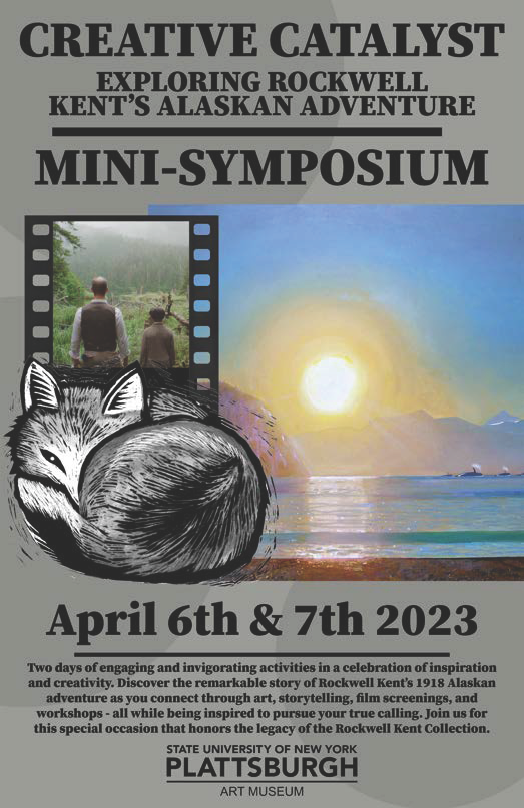
Two days of engaging and invigorating activities in a celebration of inspiration and
creativity. Discover the remarkable story of Rockwell Kent’s 1918 Alaskan adventure
as you connect through art, storytelling, film screenings, and workshops — all while
being inspired to pursue your true calling. Join us for this special occasion that
honors the legacy of the Rockwell Kent Collection.